
Grief and Loss
Hi all! It’s good to see you and I’m glad to be back again following a break: Ready to keep rocking and rolling! I don’t have any poignant words or earth-shattering wisdom today. Let’s dive in and talk about grief and loss!
Finding Light in the Shadow: Navigating Grief and Honoring Loss
Grief. It’s a word that carries immense weight, a universal experience that touches every life, yet remains deeply personal and often isolating. Grief is the natural, emotional response to loss—a tumultuous journey of sorrow, adjustment, eventual remembrance, and integration into a new sense of normalcy. While grief often feels like a solitary darkness, understanding and acknowledging this profound human experience is the first step toward finding a path through the shadow. As we approach National Grief Awareness Day on August 30th, it is a timely moment to reflect on what grief truly is, how we can navigate it, and how we can better support those around us who are walking this difficult path.
The Many Faces of Loss
When we hear the word “grief,” our minds often default to the loss of a loved one. And while the death of a loved one can be an intense experience, there are plenty of other situations we might find ourselves accompanied by grief. We grieve the loss of relationships through divorce or separation, the loss of health after a serious diagnosis, the loss of a job or career identity, the loss of a home or a way of life, and even the loss of dreams for the future.
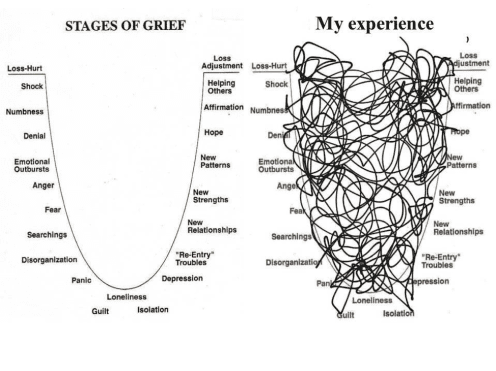
Each loss, regardless of its source, creates a void. This void triggers a cascade of emotions—shock, denial, anger, guilt, deep sadness, and even relief—that can feel overwhelming and contradictory. It’s crucial to recognize that there is no right or wrong way to grieve. The process is non-linear, unpredictable, and entirely unique to the individual. Just when you think you’ve found solid footing, a memory, a scent, or a song can send you tumbling back into the raw pain of the initial loss. This is normal. This is part of the work of integrating the loss into the story of your life.
The Non-Linear Journey: Moving Beyond “Stages”
For decades, the Kubler-Ross model of the five stages of grief (denial, anger, bargaining, depression, and acceptance) provided a framework for understanding this process. Fun fact: David Kessler expanded on Elisabeth Kubler-Ross’s work and has introduced the sixth stage of grief called “meaning.” I love this fun fact because it reminds me how grief changes over time, just like our understanding through research. While the six stages of grief are helpful for initial orientation, modern understanding emphasizes that grief is less of a staircase to climb and more of an ocean to navigate. You don’t neatly progress from one stage to the next; rather, you may feel all five emotions in a single hour, or revisit a “past” stage years later. And, some people have chosen to skip over the stages of grief entirely in favor of other analogies, like the ball-in-the-box or grief loops/wheels.
Instead of focusing on “getting over it,” the work of grief involves finding ways to live with the loss. This includes two critical, often competing tasks:
- Grieving the loss: Allowing yourself to feel the pain, sadness, and absence.
- Rebuilding and adapting: Adjusting to an environment where the person or thing lost is no longer physically present, finding new routines, and redefining your identity.
This push and pull highlights and normalizes the oscillation that people experience as they grieve. You need time for sorrow, and you also need time to step away, focus on life’s demands, and find moments of joy or distraction. Neither is a betrayal of the one you lost; both are essential for healing.
________________________________________________________________________________________________
Honoring the Absence: Finding Support and Meaning
National Grief Awareness Day serves as a powerful reminder that grief should not be endured in silence. It is an opportunity to break down the societal discomfort surrounding death and loss, and to encourage open, compassionate conversations. Here are some suggestions I have for you:
How to Navigate Your Own Grief:
- Be Patient with Yourself: Set realistic expectations. Grief takes time, and healing is not a race.
- Embrace the Feelings: Don’t try to suppress your emotions. Find healthy outlets—writing, talking, art, exercise—to process the pain. Crying is a biological release valve.
- Maintain Self-Care: Ensure you are getting adequate sleep, nutrition, and movement. Grief is physically exhausting.
- Seek Connection: Don’t isolate yourself. Lean on friends, family, or professional support. A support group can be invaluable as it connects you with others who genuinely get it.
How to Support Someone Else’s Grief:
The biggest mistake people make is trying to “fix” grief. It cannot be fixed. Instead, offer presence and practical help:
- Use Their Name: Speak the name of the person they lost. It validates their importance.
- Avoid Clichés: Phrases like “everything happens for a reason” or my personal favorite “they’re in a better place” often feel dismissive. Instead, say, “I am so sorry. I love you,” or “This must be incredibly hard.”
- Offer Specific Help: Instead of “Let me know if you need anything,” try, “I’m bringing dinner on Tuesday,” or “Can I run your errands this afternoon?”
- Just Show Up: Grief doesn’t end after the funeral. Continue checking in weeks and months later, especially on anniversaries and holidays.
Grief, ultimately, is love with no place to go. It is the deep, persistent evidence that something profoundly meaningful was once there. As you navigate the ever-changing landscape of loss, remember that the goal is not to forget, but to integrate the memory of the loved one or the past into your future—to find a way to honor the light that was, even as you learn to live with the shadow of its absence.
So there you have it! Something that’s been on my brain. I hope this finds you well. Know that I see you and I’m rooting for you. Take care of yourselves and each other.
P.S. Y’all can hear my “air quotes” in the audio. I hope it makes you smile!
Resources
- Unlocking Us Podcast: David Kessler on Grief and Finding Meaning
- Speaking of Psychology Podcast: How Grieving Changes the Brain, with Mary-Frances O’Conner, PhD
- Speaking of Psychology Podcast: Ambiguous Loss and the “Myth of Closure,” with Pauline Boss, PhD
- Kubler-Ross in Music: Songs, albums, and bands that name Elisabeth Kubler-Ross or build on her Five Stages